Introduction
Look, I’ll be blunt. Most people check their BMI once, freak out, and never think about it again. That’s a mistake. Body Mass Index is a simple screening tool—nothing more, nothing less. It uses your height and weight to estimate whether your weight falls into a healthy range.
But here’s the kicker: a BMI calculator for men and a BMI calculator for women spit out the same number for the same height and weight, yet your body composition might be completely different.
In this guide, you’ll learn how to calculate BMI, what the numbers actually mean, how it differs for kids versus adults, and why muscle-bound athletes sometimes get labeled “obese.” No fluff. No fear-mongering. Just the facts and how to use them.
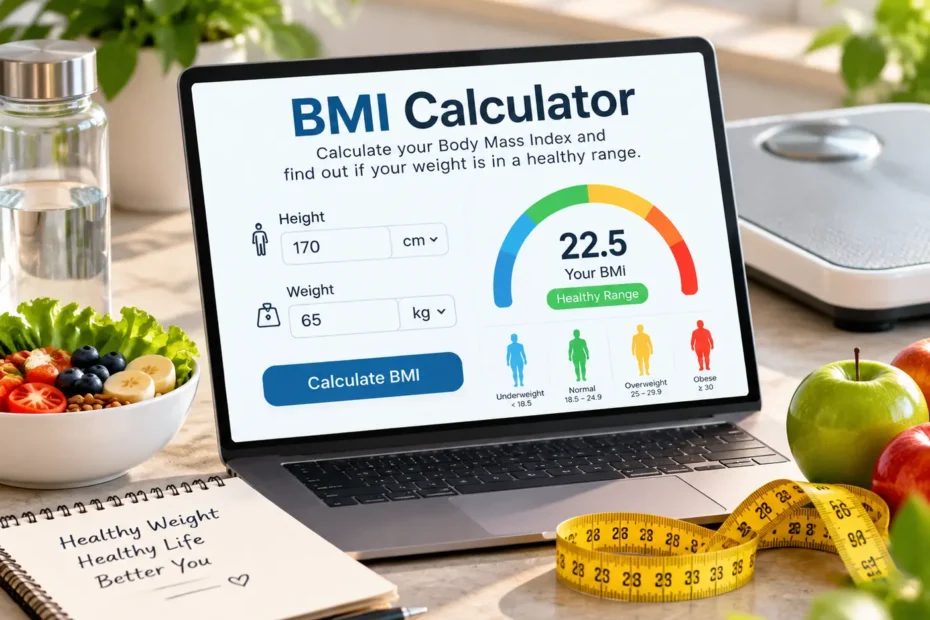
Quick Answer: BMI is your weight in kilograms divided by your height in meters squared. A healthy BMI for adults sits between 18.5 and 24.9. Below 18.5 is underweight. 25 to 29.9 is overweight. 30 and above is Obesity. Simple math—but the interpretation gets messy.
Explore How BMI Calculator: https://calcmaster.co.uk/
What Is BMI and Why Should You Care?
BMI stands for Body Mass Index. According to the Centers for Disease Control and Prevention (CDC), it’s a calculated measure of weight relative to height used to categorize adults into underweight, healthy weight, overweight, and Obesity. The World Health Organization (WHO) defines it as weight in kilograms divided by the square of height in meters (kg/m²).
Here’s why it matters: BMI is a screening tool. It flags potential health risks. Higher BMIs link to increased risk of type 2 diabetes, heart disease, high blood pressure, and certain cancers. But it’s not a diagnosis.
Key Takeaway:
- BMI is a quick screening measure, not a diagnostic tool
- It correlates with body fat for most people, but not everyone
- It’s used globally by health organizations to track population health trends
Direct Answer: BMI is a simple ratio of weight to height that helps categorize weight status and flag potential health risks.
“`htmlHow Do You Calculate BMI? (The Only Formula You Need)
The math is stupidly simple. BMI = weight (kg) ÷ height (m)².
Let me walk you through it. Say you weigh 70 kg and stand 1.70 m tall.
- Square your height: 1.70 × 1.70 = 2.89
- Divide your weight by that number: 70 ÷ 2.89 = 24.2
Your BMI is 24.2—right at the top of the healthy range.
Now, if you’re working in pounds and inches, the formula shifts slightly: BMI = (weight in pounds ÷ height in inches²) × 703. The NHS uses the metric version for its official calculator.
Key Takeaway:
- Metric: kg ÷ m²
- Imperial: (lbs ÷ in²) × 703
- Always square your height before dividing
Direct Answer: BMI is calculated by dividing your weight in kilograms by the square of your height in meters.
What’s a Healthy BMI Range? (Adults vs. Kids)
For adults 20 and older, the categories are standardized regardless of sex. According to the CDC, the breakdown looks like this :
BMI Range Category
Below 18.5 Underweight
18.5 – 24.9 Healthy Weight
25.0 – 29.9 Overweight
30.0+ Obesity
Obesity subdivides further: Class 1 (30–34.9), Class 2 (35–39.9), and Class 3 (40+), sometimes called severe Obesity.
Here’s where it gets tricky: children and teens don’t use fixed cutoffs. The CDC’s Child and Teen BMI Calculator uses sex-specific BMI-for-age percentiles because kids grow at wildly different rates. A 10-year-old with a BMI of 18 might be perfectly healthy; a 30-year-old with the same number might be underweight—different rules, different game.
Key Takeaway:
- Adult BMI categories are the same for men and women
- Kids use percentiles, not fixed numbers
- A “healthy” BMI for a child depends on age and sex
Direct Answer: For adults, a healthy BMI is 18.5 to 24.9; for children and teens, BMI is interpreted using age- and sex-specific percentiles.
BMI for Women vs. Men: Is There a Difference?
Short answer: No, not in the calculation. The WHO explicitly states BMI values are age-independent and the same for both genders in adult populations.
But—and this is a big but—body composition differs. Women naturally carry more essential fat than men. According to the NHS, people from Asian, Black African, African-Caribbean, or Middle Eastern backgrounds may face higher health risks at lower BMIs. That’s why some calculators ask for ethnic background.
So when you search for a BMI calculator for women or a BMI calculator for men, you’re getting the same formula. The interpretation might shift based on context, but the math doesn’t care about your gender.
Key Takeaway:
- The formula is identical for men and women
- Health risks at specific BMI thresholds can vary by ethnicity
- Body fat percentage tells a more complete story than BMI alone
Direct Answer: BMI calculations are identical for adult men and women; only the interpretation of health risk may vary by ethnicity and individual factors.
Why BMI Fails for Athletes (and Bodybuilders)
I’ve seen this firsthand. A friend of mine—a competitive powerlifter who deadlifts 600 pounds—got a BMI of 31. Classified “obese.” His body fat? Around 12%. The man had abs you could grate cheese on.
BMI cannot distinguish between muscle and fat. According to the NIH, BMI is an approximate indicator of tissue mass, but it doesn’t measure fat directly. A 6-foot athlete at 220 pounds and a 6-foot couch potato at 220 pounds get the same BMI. Their health profiles? Night and day.
The Brigham and Women’s Hospital calculator notes this limitation explicitly, suggesting waist measurement as a better indicator for muscular individuals.
Key Takeaway:
- BMI overestimates body fat in muscular people
- It underestimates risk in people with low muscle mass but high fat
- Waist circumference is a better complement to BMI
Direct Answer: BMI misclassifies muscular individuals as overweight or obese because it cannot differentiate between muscle and fat tissue.
BMI Calculator for Kids: A Different Beast Entirely
If you’re checking a child’s BMI, do not use adult categories. The CDC provides a dedicated Child and Teen BMI Calculator for ages 2 through 19. It calculates BMI-for-age percentiles based on sex and age.
Here’s how the categories break down :
Percentile Category
Less than 5th Underweight
5th to <85th Healthy Weight
85th to <95th Overweight
95th or greater Obesity
The WHO reports that globally, over 35 million children under 5 were overweight in 2024. Childhood obesity tracks into adulthood—overweight kids are more likely to become overweight adults with higher risks of diabetes and cardiovascular disease.
Key Takeaway:
- Never use adult BMI categories for children
- Percentiles account for growth patterns and sex differences
- Early intervention matters—habits formed young stick
Direct Answer: Children and teens use BMI-for-age percentiles, not fixed adult categories, because their bodies are still developing.
BMI Calculator by Age: Does Age Change the Number?
For adults 20 and older, age doesn’t change the BMI formula or categories. A 25-year-old and a 65-year-old with the same height and weight get the same BMI.
But age matters for interpretation. The NIH notes that BMI correlates with body fat, but the relationship varies with age and gender. Older adults tend to have more body fat at the same BMI compared to younger adults. Muscle mass declines with age, so a “normal” BMI in your 60s might mask higher fat levels than the same BMI in your 20s.
Key Takeaway:
- Adult BMI categories don’t change with age
- Body composition shifts with age—same BMI, different fat levels
- Older adults should discuss BMI with their healthcare provider
Direct Answer: Age doesn’t alter the adult BMI formula, but it affects how the number translates to actual body fat and health risk.
Beyond BMI: What Else Should You Track?
BMI is a starting point. Not the finish line. Here’s what I’d add to your dashboard:
Waist Circumference: The NHS recommends measuring your waist after getting your BMI. Carrying excess weight around your middle signals higher risk regardless of BMI.
Body Fat Percentage: More accurate than BMI, though harder to measure at home. DEXA scans, hydrostatic weighing, or smart scales give better estimates.
Blood Markers: Fasting glucose, lipid panel, blood pressure. These tell you what’s actually happening inside, not just on the scale.
Key Takeaway:
- Waist measurement adds context BMI misses
- Body fat percentage is more precise but harder to track
- Bloodwork reveals metabolic health that BMI can’t
Direct Answer: Waist circumference, body fat percentage, and metabolic markers provide a fuller health picture than BMI alone.
Frequently Asked Questions
Question: What is a healthy BMI for a woman?
Answer: A healthy BMI for adult women is 18.5 to 24.9, the same as men. However, women naturally carry more essential body fat, so a BMI near the lower end may still reflect healthy composition.
Question: How do I calculate my BMI without a calculator?
Answer: Divide your weight in kilograms by your height in meters squared. For imperial: multiply weight in pounds by 703, then divide by height in inches squared.
Question: Can BMI be wrong for muscular people?
Answer: Absolutely. BMI cannot distinguish muscle from fat. Athletes and bodybuilders often get classified as overweight or obese despite low body fat.
Question: What’s the difference between BMI for adults and children?
Answer: Adults use fixed categories (18.5–24.9 = healthy). Children use percentiles based on age and sex because their bodies change rapidly during growth.
Question: Is BMI the same for men and women?
Answer: Yes. The WHO confirms BMI values are gender-independent for adults. Health risk interpretation may vary, but the calculation doesn’t.
Conclusion
BMI is a tool. A decent one. A fast one. But not a perfect one. It gives you a quick snapshot of where your weight sits relative to your height—nothing more. For most people, it’s a useful starting point. For athletes, kids, pregnant women, and older adults, it needs context.
Use it. Don’t worship it. Pair it with waist measurements, how your clothes fit, energy levels, and actual conversations with your doctor. The number on the screen is information, not a verdict.
Bottom Line: BMI is a simple screening tool that estimates weight status based on height and weight. It’s useful for population trends and quick checks, but it can’t tell you how much muscle you have, where your fat sits, or how healthy you actually are.
Call to Action: Calculate your BMI right now using the CDC’s official adult calculator. Then measure your waist. Write both numbers down. Bring them to your next checkup. That’s how you turn a number into action.
References
- Centers for Disease Control and Prevention. “Adult BMI Calculator.” CDC.gov, 2024.
- World Health Organization. “Nutrition Landscape Information System: BMI Classification.” WHO.int.
- National Health Service. “Calculate Your Body Mass Index (BMI) for Adults.” NHS.uk, 2023.
- Centers for Disease Control and Prevention. “Child and Teen BMI Calculator.” CDC.gov, 2025.
- National Institutes of Health. “Physiology, Body Mass Index.” NCBI Bookshelf, 2023.
Pingback: Calorie Calculator for Weight Loss: 2026 Honest Guide